How Miro uses Amazon Bedrock to boost software bug routing accuracy and improve time-to-resolution from days to hours
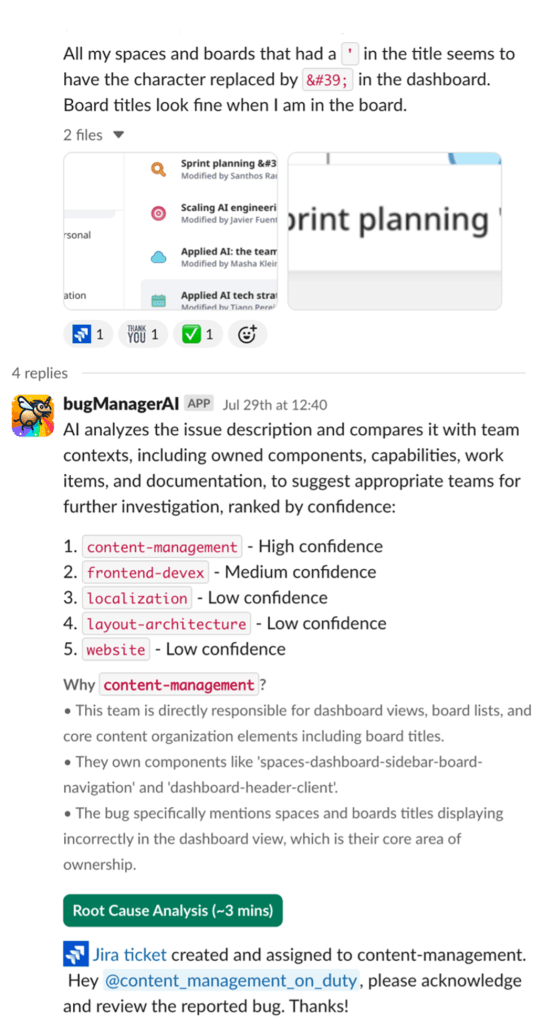
Artificial Intelligence How Miro uses Amazon Bedrock to boost software bug routing accuracy and improve time-to-resolution from days to hours This post is co-authored with Philipp Pavlov, Dmytro Romantsov, Evgeny Mironenko, and Gowri Suryanarayana from Miro. Miro is an AI-powered innovation workspace that serves over 95 million users globally, helping teams transform unstructured ideas into organized workflows. To support this scale and continue enhancing their system, Miro’s developer experience team decided to create an innovation workspace for Miro itself, using modern technologies to boost developer productivity. One of the key challenges faced by the team is efficiently routing software bugs to the responsible teams. Quick and accurate bug routing removes unnecessary context-switching, reduces developer frustration, improves time-to-resolution, and ultimately leads to a better product and happier customers. At Miro, a significant percentage of bugs miss internal resolution SLAs primarily due to misrouting and repeated reassignments between teams. This issue results in an estimated 42 years of cumulative lost productivity annually from delays and redundant investigation efforts. To tackle this problem, Miro partnered with the AWS Prototyping and Cloud Engineering (PACE) team to develop BugManager, an AI-powered solution for automated bug triaging. In this post, we dive deep into the architecture and techniques we used to improve Miro’s bug routing, achieving six times fewer team reassignments and five times shorter time-to-resolution powered by Amazon Bedrock. Challenge: Accurately routing bug reports to approximately 100 software teams Automating bug triaging in modern software environments is complex. Bug reports are often messy, lack context, and contain diverse data including text, stack traces, screenshots, and even videos. The complexity multiplies in software-focused companies with many teams, creating a multi-class classification problem with numerous possible labels. Miro’s engineering organization consists of nearly 100 teams, each responsible for specific product aspects.High-accuracy bug classification requires augmenting reports with relevant product information from various sources, including GitHub pull requests, Confluence documentation, README files, and previously resolved tickets. Additionally, organizational structures are dynamic—teams merge, new teams form, and products evolve, continuously changing team responsibilities. The same holds true for software features that are added, updated, or deprecated.Traditional natural language processing (NLP) based text classifiers, such as fine-tuned BERT models or fine-tuned large language model (LLM) classifiers, face severe limitations in these dynamic environments. They require retraining when organizational changes occur and depend on labeled data that might not exist for new structures. Miro experienced quickly degrading performance with an existing solution based on a fine-tuned GPT model.Recognizing these challenges, Miro opted for an LLM-powered approach that combines optimized prompts for team classification with Retrieval Augmented Generation (RAG) for context retrieval, creating a more adaptable, zero-training, and higher-accuracy bug triaging solution: BugManager. BugManager: RAG-based bug triaging powered by Amazon Bedrock BugManager adopts an LLM-powered approach to bug classification. When a new bug report is received, the BugManager classification system takes action. BugManager first parses non-text data such as screenshots or screen recordings using the multimodal image and video understanding capabilities of Amazon Nova Pro. The system then enriches the parsed report…