Building AI-ready data: Vanguard’s Virtual Analyst journey
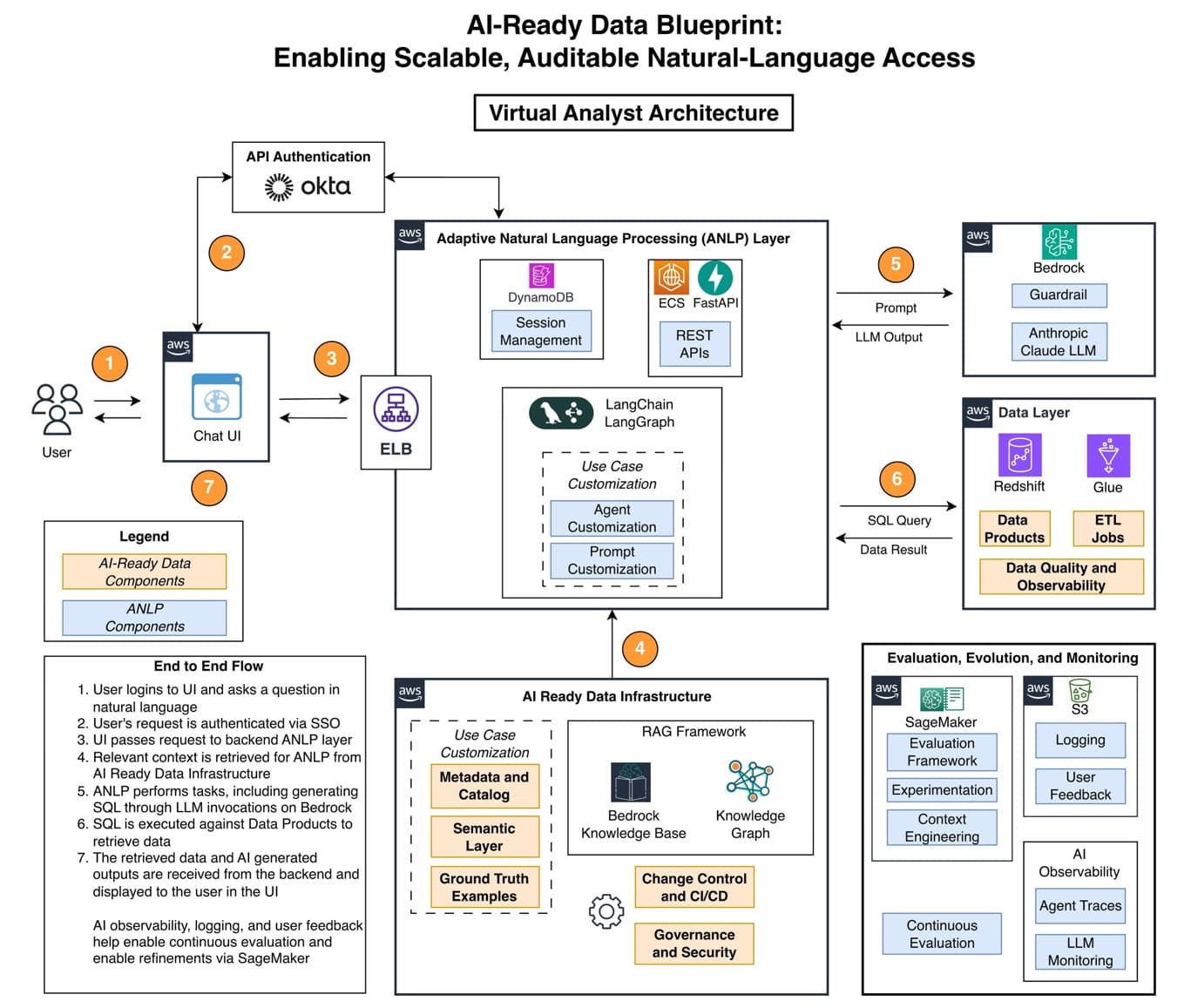
Artificial Intelligence Building AI-ready data: Vanguard’s Virtual Analyst journey Vanguard is a global investment management firm, offering a broad selection of investments, advice, retirement services, and insights to individual investors, institutions, and financial professionals. We operate under a unique, investor-owned structure and adhere to a straightforward purpose: To take a stand for all investors, to treat them fairly, and to give them the best chance for investing success. When Vanguard’s financial analysts needed to query complex datasets, they faced a frustrating reality: even basic questions required writing intricate SQL queries and sometimes long response times from data teams. This challenge is not unique to Vanguard: conversational AI is a scalable solution, providing analysts immediate responses. However, deploying conversational AI requires more than choosing the right foundation model—it requires AI-ready data infrastructure. In this post, you’ll learn how Vanguard built their Virtual Analyst solution by focusing on eight guiding principles of AI-ready data, the AWS services that powered their implementation, and the measurable business outcomes they achieved. The challenge: When AI meets enterprise data complexity Vanguard’s analysts and business stakeholders sought faster, more direct access to financial data for decision-making. The existing workflow required SQL expertise and data team support, with typical requests taking several days to fulfill. The data infrastructure required semantic context and metadata management to enable AI-powered tools to generate accurate, business-relevant insights. As the Virtual Analyst project progressed, the team discovered that building effective conversational AI wasn’t a machine learning challenge—it was a data architecture challenge. The most sophisticated foundation models require proper data foundations to deliver reliable results. This realization led to a fundamental shift in approach: instead of focusing solely on AI capabilities, Vanguard needed to build what they termed AI-ready data. The collaborative imperative: Breaking down silos Building Virtual Analyst requires something many organizations struggle with: getting traditionally siloed teams to work together. Vanguard brought together data engineers, business analysts, compliance officers, security teams, and business stakeholders. Each team brought critical expertise: - Data engineers understood the technical infrastructure - Business analysts knew the semantic meaning of financial metrics - Compliance teams helped meeting regulatory requirements - Business users provided the real-world context for how they are going to use the insights. This cross-functional collaboration became the foundation for AI by developing a well-defined, cross-functional operating model where ownership models, semantic definitions and quality standards were well understood and activated. The team realized that without clear ownership models, semantic definitions, and quality standards that all teams could understand and contribute to, the AI solution would not have a good foundation. The Virtual Analyst project served as a catalyst for new processes and frameworks that provide benefits far beyond the initial AI use case. The following figure shows the AI-ready data blueprint that was developed for the Virtual Analyst architecture. Case Study: Virtual Analyst Vanguard chose AWS for its comprehensive suite of integrated services. AWS offers a rich feature set for building AI-ready data architectures, from the advanced analytics capabilities of Amazon Redshift to the…