Scaling Trusted Access for Cyber with GPT-5.5 and GPT-5.5-Cyber

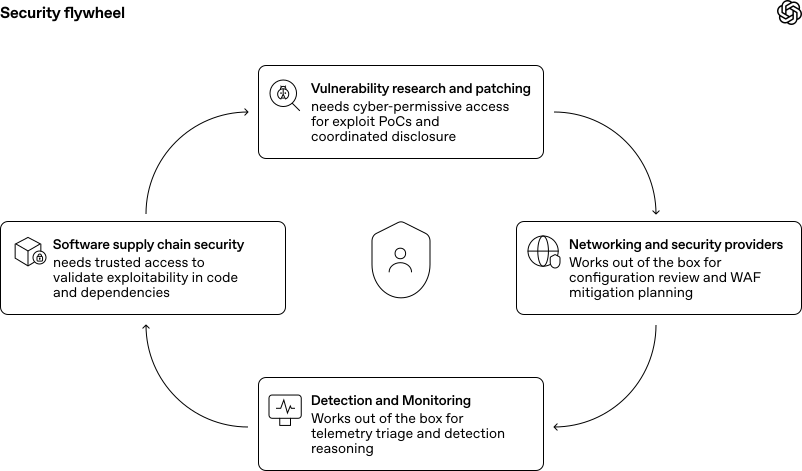
Scaling Trusted Access for Cyber with GPT‑5.5 and GPT‑5.5‑Cyber How our latest models help each layer of the defensive ecosystem and accelerate the security flywheel. For years we’ve been chronicling our work to accelerate cybersecurity defenders, as part of our broader work to build the core infrastructure for AI. Last week, we released our action plan Cybersecurity in the Intelligence Age, which lays out our vision for democratizing AI-powered defense. Two weeks ago, we released GPT‑5.5, our smartest and most intuitive model to date, which is already delivering powerful cybersecurity capabilities to developers and security teams through Trusted Access for Cyber (TAC). Today, we are rolling out GPT‑5.5‑Cyber in limited preview to defenders responsible for securing critical infrastructure to support specialized cybersecurity workflows that help protect the broader ecosystem. We are focused on providing proportional safeguards and access to empower cyber defenders to protect society, and our approach has been informed by conversations with cybersecurity and national security leaders across federal and state government and major commercial entities. The cyber defense ecosystem is broad, and GPT‑5.5 and GPT‑5.5‑Cyber play different roles in meeting the needs of organizations and researchers across it, depending on the task, the setting, and the safeguards around how the model is used. For most teams, GPT‑5.5 with TAC is our strongest broadly useful model for legitimate defensive work, with strong safeguards against misuse. In this post, we are sharing more details on how Trusted Access for Cyber works, how GPT‑5.5 and GPT‑5.5‑Cyber meet the varied needs of defenders across the ecosystem, and how different levels of access affect model outputs. Trusted Access for Cyber is an identity and trust-based framework designed to help ensure enhanced cyber capabilities are being placed in the right hands. It is designed to make the cyber capabilities of GPT‑5.5 more useful for verified defenders working on defensive tasks, while continuing to restrict requests that could enable real-world harm. When defenders are vetted and approved for Trusted Access for Cyber, they receive lower classifier-based refusals to enable authorized cybersecurity workflows, including vulnerability identification and triage, malware analysis, binary reverse engineering, detection engineering, and patch validation. Safeguards continue to block malicious activity such as credential theft, stealth, persistence, malware deployment, or exploitation of third-party systems. As we announced last week, with increased access, defenders are required to have phishing-resistant account security protections. Individual members of Trusted Access for Cyber accessing our most cyber capable and permissive models will be required to enable Advanced Account Security beginning June 1, 2026. Organizations with trusted access can, as an alternative, attest that they have phishing resistant authentication as part of their single sign-on workflow. Here is a breakdown for how to think about the current trusted access levels: The differences between model access levels are most pronounced when comparing prompts and responses. The first example illustrates how GPT‑5.5 compares to GPT‑5.5 with Trusted Access for Cyber on a defensive task: create a proof-of-concept from a published vulnerability to validate remediation within an authorized environment. For most…