I've Covered Robots for Years. This One Is Different
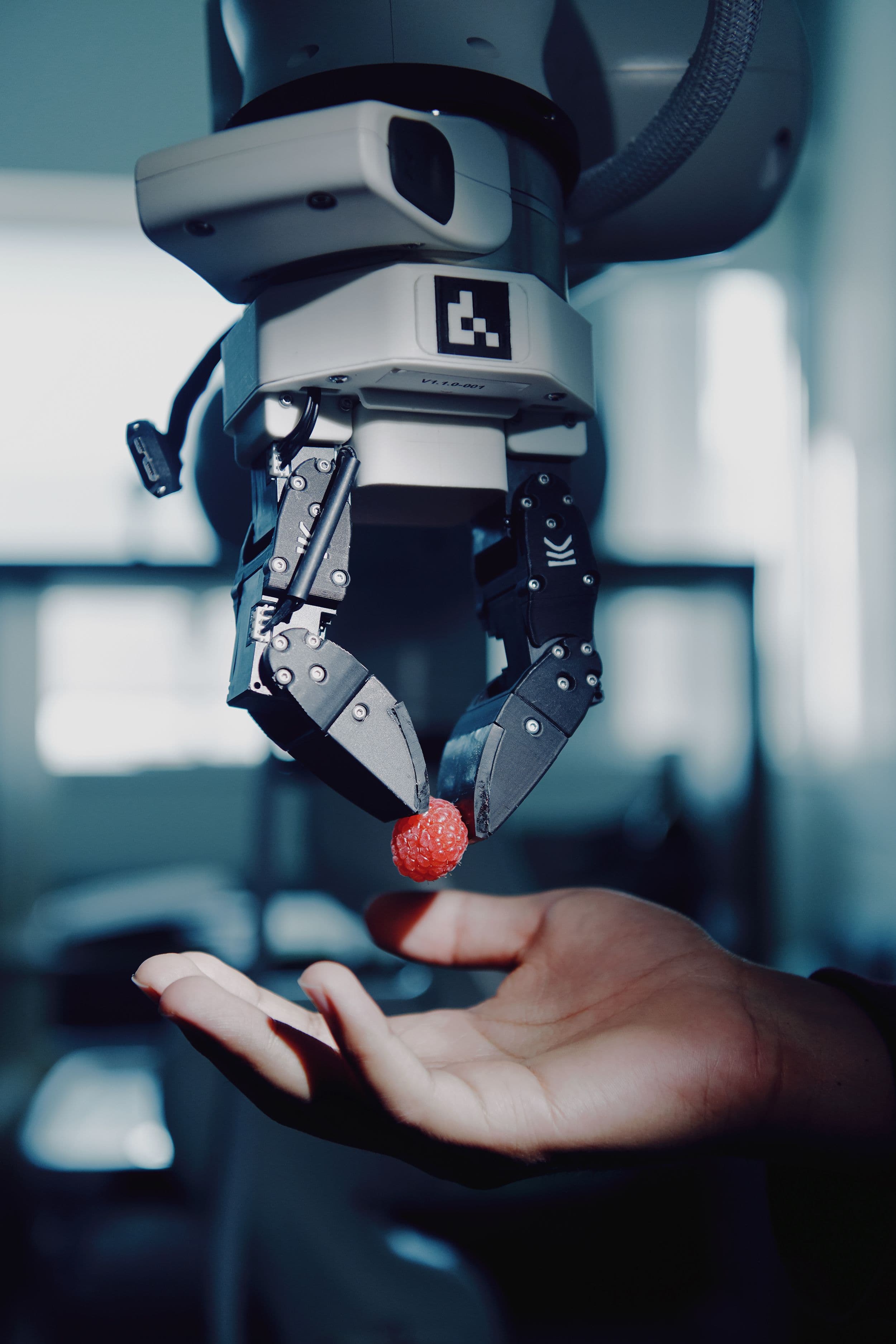
A robot’s claw hurtles toward a light bulb on a table. I wince, waiting for the crunch. But suddenly the claw decelerates. It starts gingerly pawing around the table, as if searching for its glasses on the nightstand. It gently positions the bulb between its two pincers. The bulb rolls away. The claw goes chasing it across the table. After a few nips, the bulb is back in its grasp. The robot swiftly screws the bulb into a nearby socket, illuminating its work area. In more than a decade of writing about robots, I have never seen one move so naturally. Most are ham-fisted klutzes, even when remotely controlled by a person. Of the few dozen robot arms on the market today, not one can screw in a light bulb. I have come to visit Eka, a startup located in Kendall Square, Cambridge, Massachusetts, a short walk from MIT and a slightly longer bike ride from my home. The company’s office is a few floors above one of my favorite restaurants, called Shy Bird, a place I often come to work with my own pincers—typing out stories for WIRED. Eka’s office is small, and it’s packed with different robot arms, assorted grippers and hands, and tables covered with odd knicknacks of different shapes, sizes, and textures—gloves, small boxes of earplugs, hairbrushes, key rings, and so on. I try putting a few things beneath the robot. First the earplugs box, then a hairbrush, and finally—in an attempt to trip it up—my own jumble of keys, which have a plush key ring. Each time, the robot swoops down and nips gently at the item a few times before grasping and lifting it up. When I try to take my keys back from Eka’s machine, the robot resists for just a moment, then lets go and instantly turns its attention back to the table, hunting for something else to pick up. Its dedication to picking is impressive. It is also kind of freaky. Watching Eka’s robot in action reminds me of the first time I tried talking to ChatGPT. The robots are so fluid, so natural-seeming, that I can’t help but feel there’s something genuinely intelligent, if not quite human, behind them. In a conference room not far from the robots, Eka’s cofounders, Pulkit Agrawal, a professor at MIT, and Tuomas Haarnoja, an ex-Google DeepMind robotics researcher, lay out their vision for the curious new machine. “A couple of years ago, we realized that dexterity can finally be cracked,” Agrawal says. Eka’s robot demos suggest that the company’s approach should enable real robot dexterity with further training. If that’s true, it could revolutionize how robots are used—not only in factories and warehouses but also in shops, restaurants, even households. “Trillions of dollars flow through the human hand,” Agrawal says. “To me, this is the biggest problem in the world to be solved.” The two men believe they are halfway there. Solving dexterity, they say, is now just a question of scaling up the…