Building web search-enabled agents with Strands and Exa
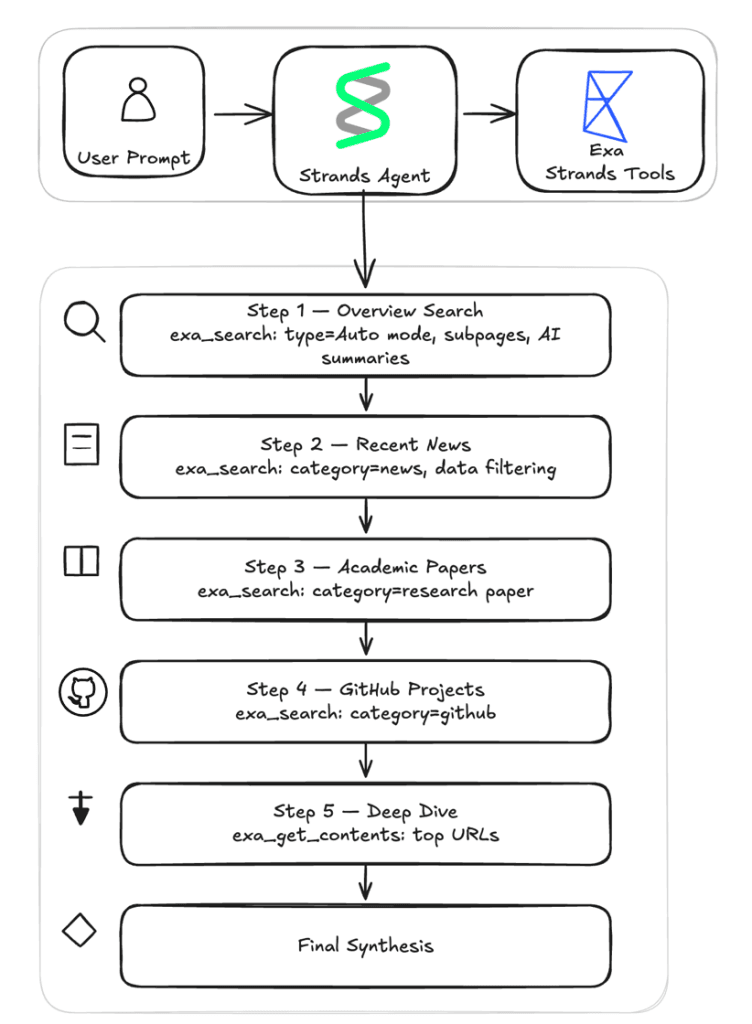
Artificial Intelligence Building web search-enabled agents with Strands and Exa This post is co written by Ishan Goswami and Nitya Sridhar from Exa. If you are building web search-enabled AI agents for research, fact-checking, or competitive intelligence, access to current and reliable information is critical. Most general-purpose search APIs are not designed for agent workflows. They return HTML-heavy pages and short snippets optimized for human browsing, not structured data that an agent can directly consume. As a result, developers often need to build additional layers, custom crawlers, parsers, and ranking logic, to transform this content into something usable within an agent workflow. The Exa integration for the Strands Agents SDK addresses this gap with an AI-native search and retrieval layer built directly into the tool interface. Exa delivers clean, structured content formatted for direct use in LLM context windows, without requiring post-processing to strip markup or reformat output. Combined with the Strands Agents SDK’s model-driven architecture, where the model decides when to invoke tools and how to use their outputs, agents can draw real-time web knowledge into their reasoning loop. In practice, your agent accesses this integration through two tools: exa_search , which performs semantic search with support for categories like news, research papers, and repositories, and exa_get_contents , which retrieves full content from selected URLs. In this post, you will learn how to set up the Exa integration in Strands Agents, understand the two core tools it exposes, and walk through real-world use cases that show how agents use web search to complete multi-step tasks. Strands Agents The Strands Agents SDK is an open source framework from AWS for building AI agents using a model-driven approach. Rather than writing hard-coded workflows that dictate every step, developers provide a model, a system prompt, and a list of tools. The model itself decides what to do next: which tools to call, in what order, and when the task is done. At the core of Strands Agents is the agent loop. On each iteration, the model receives the full conversation history, including every prior tool call and its result. If the model needs more information, it requests a tool; Strands Agents executes it and feeds the result back. The loop continues until the model produces a final answer. This accumulation of context across iterations is what makes agents capable of tackling multi-step tasks that go beyond what a single LLM call can handle. The Strands Agents SDK ships with over 40 pre-built tools covering file I/O, shell execution, web search, AWS APIs, memory, code execution, and more. It also supports Model Context Protocol (MCP), so tools exposed by MCP servers are available to an agent without additional integration work. Adding new tools, including the Exa web search tools, follows the same pattern: drop them into the `tools=[]` list and the model learns how to use them from their signatures. Exa Exa is a web-scale search engine built specifically for LLMs and AI agents. Exa is a search engine that understands the meaning…