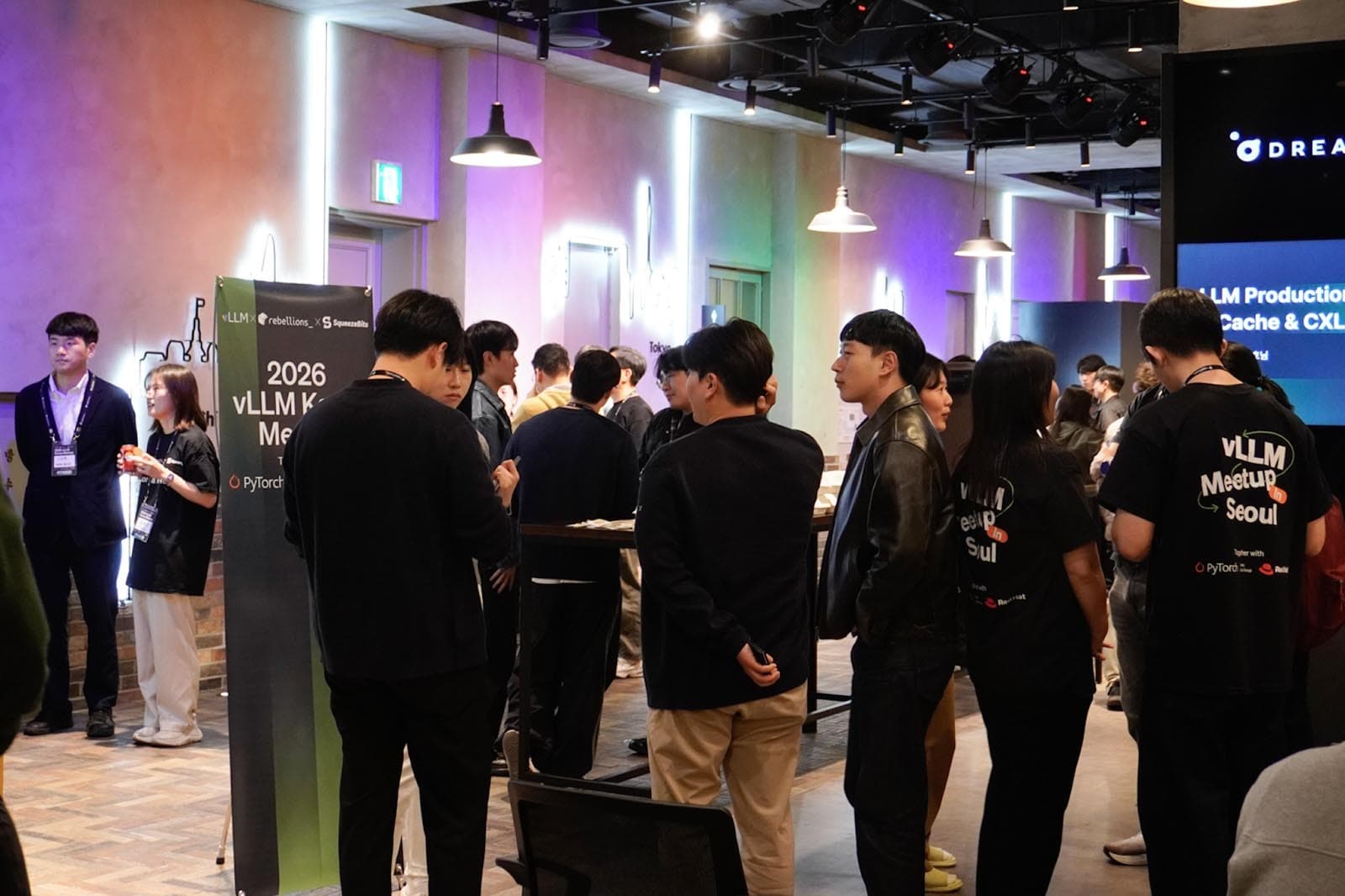
vLLM Korea Meetup 2026 Wrap-Up Apr 14, 2026 · 7 min read Hosted by the vLLM KR Community, with support from Rebellions, SqueezeBits, Red Hat APAC, and PyTorch Korea, the vLLM Korea Meetup 2026 was held in Seoul on April 2nd.
vLLM Korea Meetup 2026 Wrap-Up Hosted by the vLLM KR Community, with support from Rebellions, SqueezeBits, Red Hat APAC, and PyTorch Korea, the vLLM Korea Meetup 2026 was held in Seoul on April 2nd. This meetup proved to be much more than a standard tech event. Not only did it see strong turnout on the day, but the post-event survey recorded an impressive ~75% response rate — a testament to the active engagement of the attendees. Results reflected high overall satisfaction, confirming that the meetup delivered both in-depth practical content and a genuine community experience. Field engineers from a wide range of companies and research institutions gathered to share real-world deployment stories and infrastructure strategies for running LLMs in production. As AI moves beyond the research phase and into full-scale services, handling inference workloads efficiently has become a central challenge. Against this backdrop, vLLM is rapidly establishing itself as the foundational infrastructure for high-performance LLM serving, seeing adoption across environments from cloud to enterprise. Intro: The Expansion and Standardization of the vLLM Ecosystem The meetup opened with Dr. Hongseok Kim from Rebellions and Li Ming from Red Hat APAC sharing the latest vLLM project updates and community news. Dr. Kim introduced the operational structure the vLLM KR community has built over the six months since its inaugural meetup — a Steering Group-centered governance model supported by regular meetups and hands-on workshops. On the technical side, he highlighted vLLM's complete architectural migration from v0 to v1, which simplifies the codebase and strengthens modularity. Internal structural changes — including async scheduling and Model Runner improvements — have been accompanied by rapid feature expansion: a streaming API, semantic router, and vLLM-Omni. Li Ming introduced vllm-playground, designed to lower vLLM's notoriously high barrier to entry (140+ configuration parameters). The GUI-based tool shortens time-to-first-run, supports CPU and macOS environments, and includes performance visualization — making it significantly easier for teams to experiment with and adopt vLLM. The message from this session was unambiguous: LLM serving is no longer just a question of which framework to pick. It has grown into an infrastructure challenge — one that needs to run efficiently across vastly different environments. Integrating AI Accelerators with vLLM Dr. Kim also covered the integration roadmap between vLLM and AI accelerator hardware. Rebellions, an AI semiconductor company, is developing the vllm-rbln plugin to bring its proprietary NPUs into the vLLM ecosystem. Core features like paged attention and continuous batching are already implemented and supported in the NPU environment. More advanced capabilities — including speculative decoding, distributed KV cache, and prefill/decode disaggregation — are currently in development, with next-generation NPUs like the Rebel100™ opening the door to large-scale inference cluster deployments. This approach reflects a broader industry shift: rather than hardware-specific, siloed optimizations, AI inference infrastructure is being restructured around vLLM as the common layer connecting diverse accelerators. vLLM Production Stack: Present and Future In the third session, Taesoo Kim, CTO of SqueezeBits, presented on the vLLM production stack — covering what it currently offers in…