Transform retail with AWS generative AI services
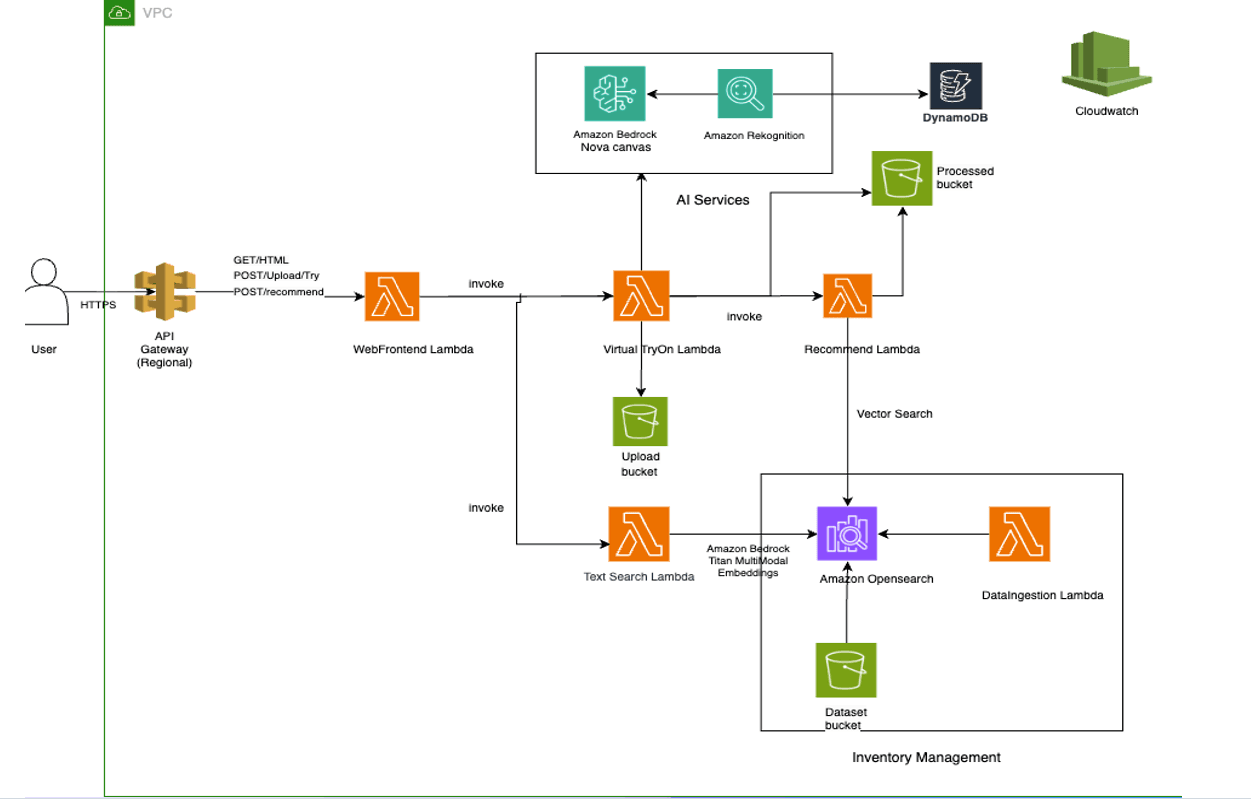
Artificial Intelligence Transform retail with AWS generative AI services Online retailers face a persistent challenge: shoppers struggle to determine the fit and look when ordering online, leading to increased returns and decreased purchase confidence. The cost? Lost revenue, operational overhead, and customer frustration. Meanwhile, consumers increasingly expect immersive, interactive shopping experiences that bridge the gap between online and in-store retail. Retailers implementing virtual try-on technology can improve purchase confidence and reduce return rates, translating directly to improved profitability and customer satisfaction. This post demonstrates how to build a virtual try-on and recommendation solution on AWS using Amazon Nova Canvas, Amazon Rekognition and Amazon OpenSearch Serverless. Whether you’re an AWS Partner developing retail solutions or a retailer exploring generative AI transformation, you’ll learn the architecture, implementation approach, and key considerations for deploying this solution. You can find the code base to deploy the solution in your AWS account in the GitHub repo. Solution overview This solution demonstrates how to build an AI-powered, serverless retail solution. The service delivers four integrated capabilities: - Virtual try-on: Generates realistic visualizations of customers wearing or using products through Amazon Nova Canvas and Amazon Rekognition - Smart recommendations: Provides visually aware product suggestions using Amazon Titan Multimodal Embeddings to understand style relationships and visual similarity - Smart search: Enables natural language product discovery with goal-oriented intelligence that understands customer intent. Uses OpenSearch Serverless for vector similarity matching - Analytics and insights: Tracks customer interactions, preferences, and trends using Amazon DynamoDB to optimize inventory and merchandising decisions The architecture uses serverless AWS services for scalability and uses a modular design, allowing you to implement individual capabilities or the complete solution. Pre-built architecture components The solution runs on AWS serverless infrastructure with five specialized AWS Lambda functions, each optimized for specific tasks: web front-end (chatbot interface), virtual try-on processing, recommendation generation, dataset ingestion, and intelligent search. The architecture uses S3 buckets for secure storage, Amazon OpenSearch Serverless for vector similarity search, and DynamoDB for real-time analytics tracking. Scalability and deployment Built using AWS Serverless Application Model (AWS SAM), the entire solution deploys with a single command and automatically scales based on demand. Reserved concurrency limits help prevent resource contention, while Amazon API Gateway caching and presigned URLs optimize performance. The microservices approach allows independent scaling and updates of each component. Integration flexibility for partners and customers The modular design allows implementation of individual capabilities or the complete solution. Documentation, sample test images, and utility scripts for dataset management make it straightforward for developers to customize and extend the solution for specific retail needs. Prerequisites Before beginning the deployment process, verify you have the following prerequisites configured: AWS account setup - An active AWS account with administrative privileges - AWS Command Line Interface (AWS CLI) installed and configured with appropriate credentials - This solution requires Amazon Nova Canvas, Amazon Titan Multimodal Embeddings, Amazon Rekognition, and Amazon OpenSearch Serverless in the same Region. Deploy in US East (N. Virginia) – us-east-1 (recommended). Regional availability for Amazon Bedrock models changes over…