Synthesize Realistic 3D Medical Images at Scale to Ship Pre‑Trained Models
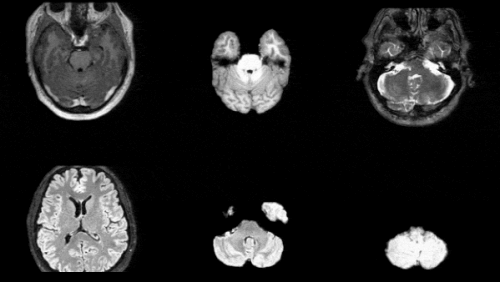
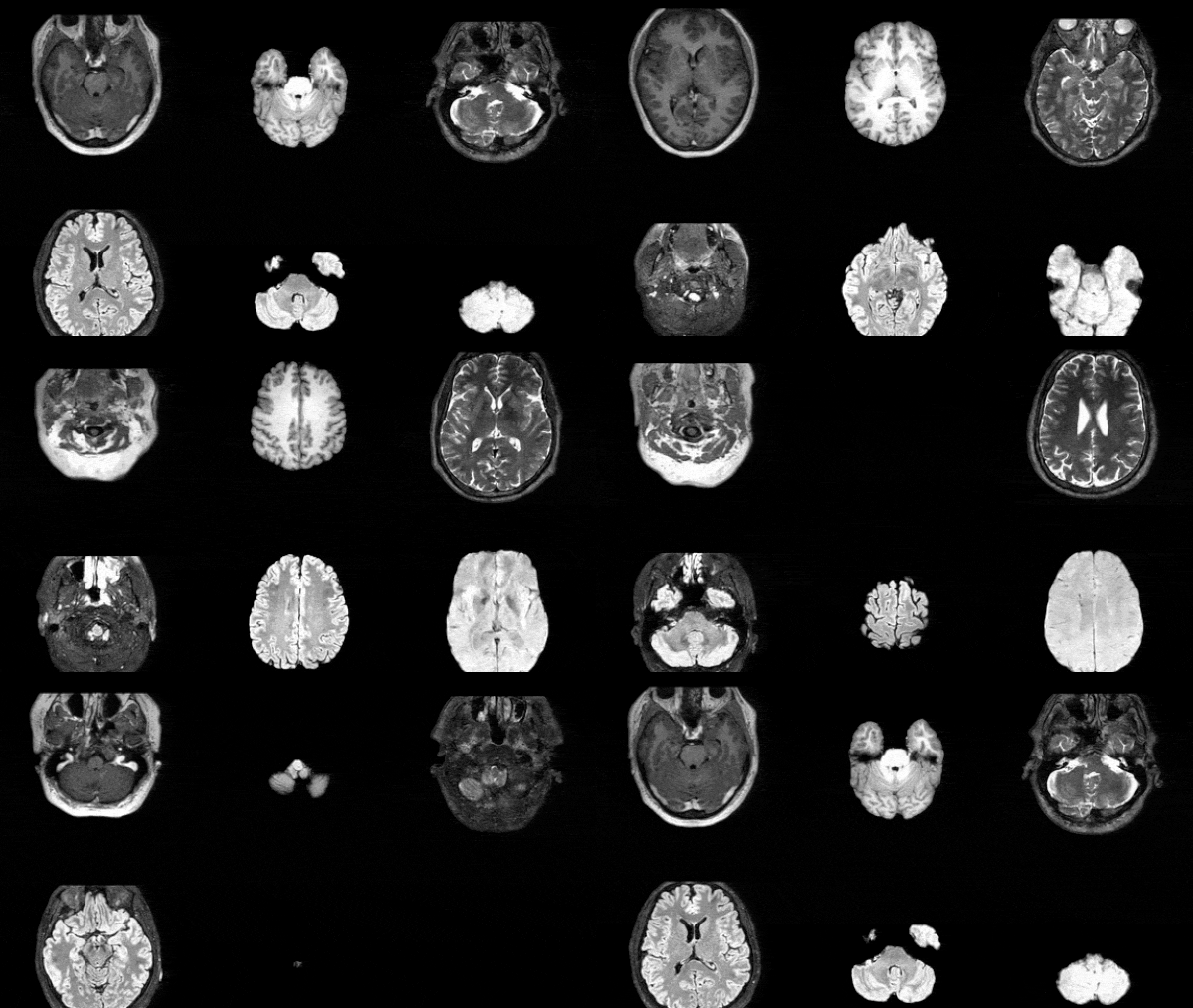
High‑quality 3D medical imaging data is the foundation of modern radiology AI, but access to it is often constrained by data scarcity, privacy restrictions, and the high cost of expert annotation. As a result, training reliable 3D medical imaging models is frequently bottlenecked by small, narrow, and hard‑to‑share datasets, limiting model robustness and generalization. To help teams overcome these challenges, NVIDIA introduced Medical AI for Synthetic Imaging (MAISI) in 2024—a state‑of‑the‑art generative model that synthesizes high‑resolution 3D CT volumes with pixel‑level anatomical segmentation for privacy‑preserving data augmentation and research. NV-Generate-CTMR, built on the MAISI architecture family, including MAISI‑v2 with Latent Rectified Flow, delivers an open source, end-to-end framework for synthetic CT and MRI generation. It enables researchers and developers to generate realistic 3D volumes and paired segmentations at scale, integrate them directly into training pipelines, and accelerate downstream medical imaging AI development. This blog post introduces NV-Generate-MR-Brain, a new model for the synthetic generation of human brain anatomy and structure segmentation built on the MAISI architecture and extending it toward scalable, open workflows for synthetic 3D medical imaging generation. Breaking the 3D medical imaging data bottleneck NV-Generate-MR-Brain was trained on the newly released multimodal MR-RATE dataset from University of Zurich, Medipol University Hospital, Forithmus and NVIDIA. The MR-RATE dataset builds on the highly successful CT-RATE dataset and multimodal foundation models. MR-RATE, the world’s largest open source multimodal MRI dataset, comprises 100,000 brain MRI studies from more than 83,000 patients—totaling about 700,000 volumes—each paired with de‑identified radiology reports, clinical, and scanner Digital Imaging and Communications in Medicine (DICOM) metadata. The dataset was created to establish an open, large‑scale foundation for developing both research and commercial AI systems that understand both imaging and clinical context. MR‑RATE captures the diversity of real‑world neuroimaging practice, spanning different scanner types, imaging protocols, and neurological pathologies. The MR-RATE dataset is being released with an open CC-BY-NC license for research institutions with commercial licenses available through Forithmus. Open source by design The repository includes end‑to‑end inference code, pretrained weights, and training configurations, enabling teams to get started immediately without rebuilding complex pipelines from scratch. Users can generate synthetic images out of the box or fine‑tune the models on their own datasets to adapt to new anatomies, scanners, or modalities—significantly lowering both technical and compute barriers. For this project all of the ingredients including code, data, and models are released with open source licenses with most models being released under the NVIDIA Open Model License. Inferencing for these models can be run on NVIDIA RTX GPUs royalty-free to generate images, fine-tune the model on new data, or new use cases. Why image generation is essential for medical AI Medical image synthesis has rapidly become a core capability for medical AI development. Teams use synthetic data to augment limited training sets, translate between imaging modalities such as CT and MRI, simulate rare pathologies, and enable privacy‑preserving data sharing without exposing real patient information. By generating realistic, anatomically consistent 3D volumes—often paired with segmentation labels—synthetic data helps models generalize better…