SMG: The Case for Disaggregating CPU from GPU in LLM Serving
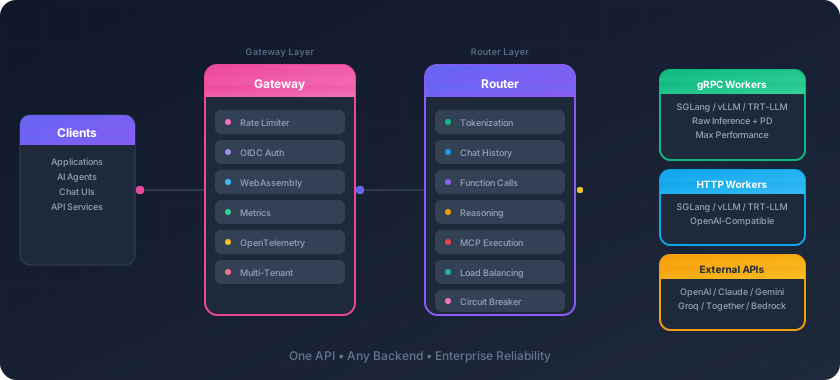
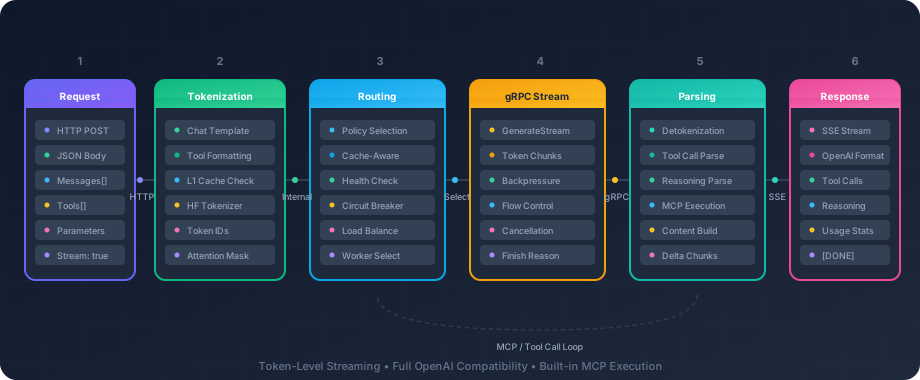
How It Started: Hitting the GIL Wall at Scale We’ve been running production model serving for many years. When we first started building Shepherd Model Gateway, the goal was modest: figure out if cache-aware load balancing could improve routing across inference replicas. It could. And as we went deeper, we found a much bigger problem. In both SGLang and vLLM, tokenization and detokenization had become bottlenecks. Not in theory — in production, under real traffic. The root cause was architectural: although both engines use Rust or C++ tokenizer libraries underneath, the calls go through Python. That means the GIL. That means a single-threaded ceiling on CPU-bound work that sits directly in the serving path. At a small scale, this doesn’t matter. At large-scale prefill-decode disaggregated serving, and at large-scale expert parallelism across GPU clusters, it matters enormously. These configurations make GPUs extremely fast — fast enough that the CPU side of the pipeline becomes the constraint. Every microsecond of GIL-bound tokenization is a microsecond where GPUs worth hundreds of thousands of dollars sit idle, waiting for input. That’s where the journey really started. Not with a gateway vision — with a production problem. Could we disaggregate the entire CPU workload from the GPU path and run it in Rust? Not Python-calling-Rust. Pure Rust. No GIL. No single-threaded ceiling. No Python process boundaries. The answer was yes, and the project that proved it became Shepherd Model Gateway. SMG Architecture: Clients → Gateway → Router → Workers SMG’s architecture is built on one principle: GPUs should do tensor math. Everything else belongs in a dedicated serving layer. We looked at the model-serving stack and identified every CPU-bound workload entangled with GPU inference: tokenization, detokenization, reasoning output parsing, function call extraction, MCP tool orchestration, multimodal preprocessing, chat history management, structured output validation, stop sequence detection. Each one is a CPU task that, when co-located with the GPU process behind the Python GIL, creates back-pressure on the most expensive hardware in the rack. SMG moves all of these into a Rust gateway layer that communicates with inference engines over gRPC. The protocol is minimal and GPU-focused: send preprocessed tokens in, stream generated tokens out. Everything else is the gateway’s responsibility. This isn’t the approach most projects in the distributed inference space have taken. Excellent work is happening with projects like NVIDIA Dynamo and llm-d, which focus on optimizing the inference engine layer and the orchestration around it. We see that work as complementary. But SMG’s bet is different: rather than making the engine smarter, make the gateway smarter. Offload everything that doesn’t require a GPU onto a purpose-built Rust layer that scales independently, evolves independently, and runs with zero GIL contention. The gRPC Re-Architecture: Making It Real The gRPC Pipeline: Gateway-side processing before engine handoff The single largest technical investment in SMG’s history was rebuilding the entire serving pipeline around a native Rust gRPC data plane. This was the architectural proof of the disaggregation thesis. Tokenization and detokenization move into the gateway. SMG runs…