Mastering Agentic Techniques: AI Agent Evaluation
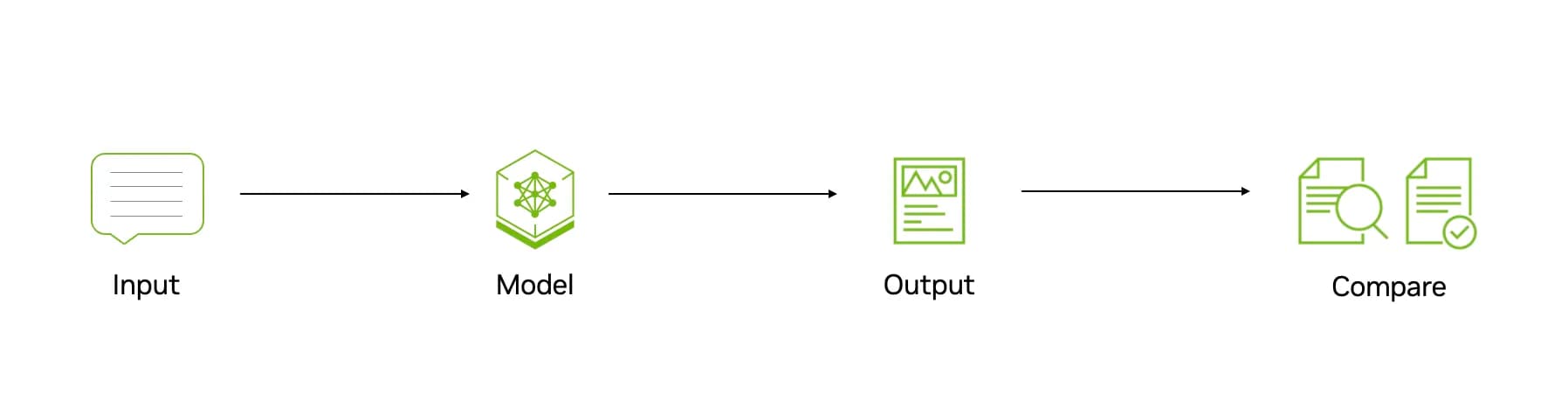
Evaluating an AI model and evaluating an AI agent are related—but they answer fundamentally different questions. A model benchmark tests the capability of a foundation model (how well it understands language, follows instructions, or solves problems on static tasks). An agent evaluation tests the behavior of a system operating end-to-end—planning, calling tools, handling uncertainty, and completing real workflows in a dynamic environment. This post explains the key differences between model and agent evaluation and walks through five practical tips for evaluating AI agents as production systems. This evaluation approach focuses on trajectories, tools, and outcomes—not just model scores. To learn about customizing AI agents, see Mastering Agentic Techniques: AI Agent Customization. What’s the difference between evaluating an AI model and evaluating an AI agent? While model and agent evaluation are inextricably linked, their technical benchmarks and metrics for success are fundamentally different. AI model evaluation: The capabilities baseline Evaluating a model focuses on the foundation model (an LLM, or VLM, for example) in isolation. It measures raw cognitive and linguistic potential using static datasets where the input-to-output mapping is predefined. Teams primarily rely on benchmarks like MMLU for general knowledge, GSM8K for mathematical reasoning, and HumanEval for coding proficiency. Ultimately, the goal of model evaluation is to answer a single question: “Is this engine powerful enough to understand my instructions and reason through facts?” AI agent evaluation: The performance trajectory Agent evaluation shifts the lens to the trajectory: the end-to-end sequence of reasoning, tool calls, and environment observations. An agent might use a top-tier model but fail because it hallucinated a JSON schema for an API or entered an infinite loop after a failed search. Agent evaluation moves into dynamic environments using the GAIA benchmark for real-world assistance, SWE-bench for resolving GitHub issues, and WebArena for web-based task execution. Technically, this evaluation requires tracking Task Success Rate (TSR) to measure intent resolution, Tool Call Accuracy to ensure precision in function calling, and Trajectory Efficiency to identify redundant steps. While a high MMLU score is a prerequisite, it doesn’t guarantee a reliable agent. The goal shifts from measuring knowledge to measuring outcomes. The question becomes: “Can this system reliably execute a multistep workflow in a nondeterministic environment?” How to evaluate an AI agent This section walks through five practical tips for evaluating an AI agent. Tip #1: Measure task success, not just accuracy Model benchmarks such as MMLU, GSM8K, and HumanEval indicate whether an agent’s base model is capable, not whether the agent can complete real tasks in your stack. For agent evaluation, prioritize TSR: - Define tasks as intent plus constraints; for example: “Update this record through this API within two tool calls.” - Measure success only when the agent fully resolves the intent within those constraints. - Track TSR per scenario (normal, degraded tools, ambiguous instructions) to expose brittleness. Traditional accuracy on the final answer becomes a secondary diagnostic under TSR. Tip #2: Evaluate full trajectories, not just final answers Two agents can provide the same answer while behaving…