How To Use AI for the Ancient Art of Close Reading
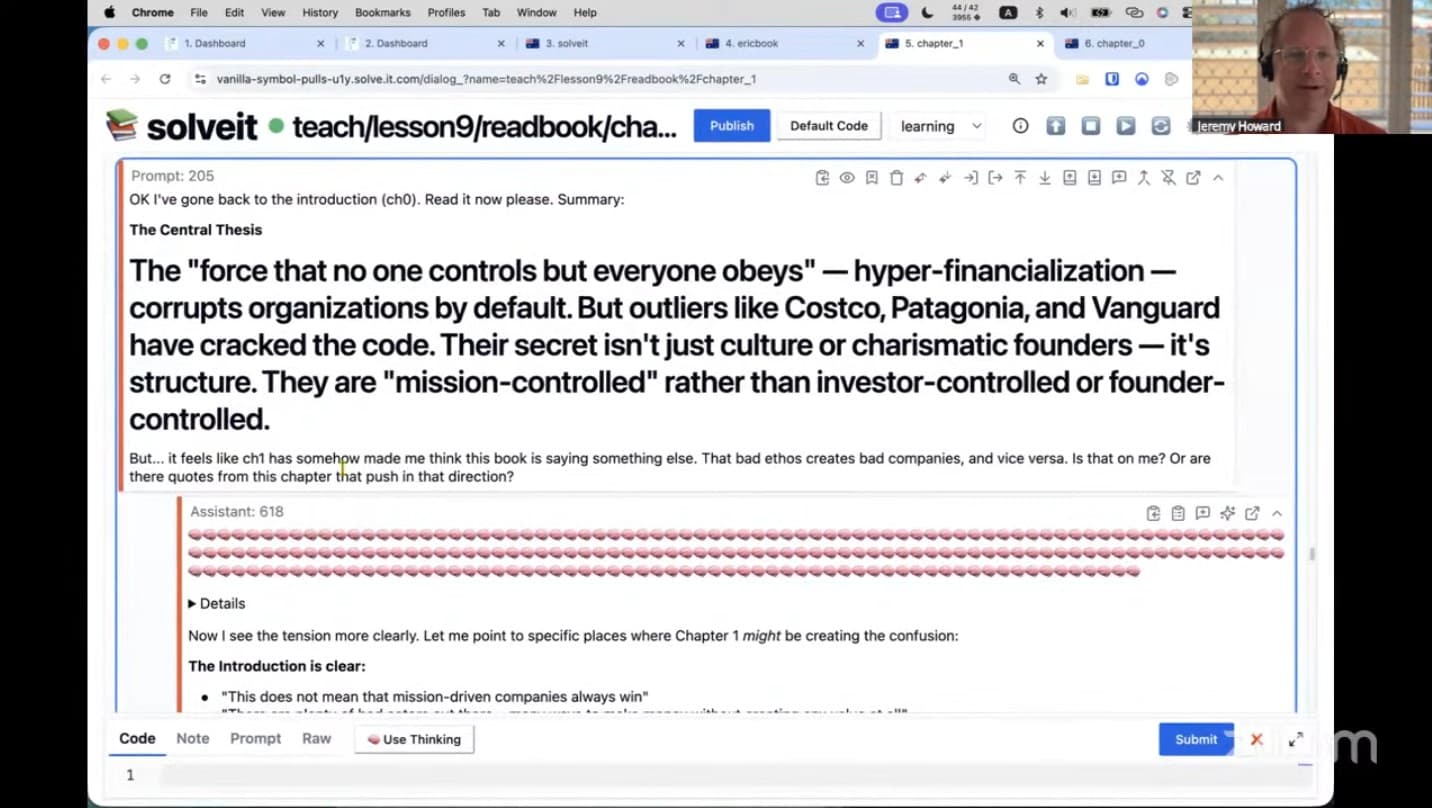
The Ancient Art of Close Reading Close reading is a technique for careful analysis of a piece of writing, paying close attention to the exact language, structure, and content of the text. As Eric Ries described it,“close reading is one of our civilization’s oldest and most powerful technologies for trying to communicate the gestalt of a thing, the overall holistic understanding of it more than just what can be communicated in language because language is so limited.” It was (and in some cases still is) practiced by many ancient cultures and major religions. Some scholars describe close reading as “‘reading out of’ a text rather than ‘reading into’ it”, referring to the importance of making outward connections to broader context. LLMs can provide a useful tool for identifying these outward connections. It might come as a surprise that a technique associated with such a long history could now see a revival with the use of Large Language Models (LLMs). With an LLM, you can pause after a paragraph to ask clarifying questions, such as ‘What does this term mean?’ or ‘How does this connect to what came before?’ Two Examples of Reading with an LLM Watching the videos below will give you the clearest examples of how reading with an LLM can work. However, I will do my best to summarize our findings below. The videos are excerpts from the most recent fast.ai course, How to Solve It With Code. Jeremy read an early version of Eric Ries’s new book, Incorruptible. He discusses his approach to Eric, demonstrating how he managed context, sharing his discoveries, and they both reflect on the experience. A second demo looks not at a book, but at a dense academic paper. Johno Whitaker used a cutting-edge paper from Yann LeCun (LeJEPA) as an example. He walks through how he prepares his workspace, investigates both math and code from the paper, and creates a simple visual interaction in order to build intuition. Benefits of Close Reading with an LLM Here are a few examples from Jeremy’s experiences that stood out to me as benefits of reading with an LLM: he was able to go down rabbit holes of interest, ask clarifying questions, and personalize the material. One chapter of Eric’s book discusses a disastrous CEO who moved from 3M to Boeing, causing problems at both companies with his focus on cost-cutting. He won “CEO of the Year”, yet oversaw the development of the Boeing 737 MAX, which later experienced fatal crashes. Jeremy was intrigued and searched for more information, discovering that this CEO was one of 13 unsuccessful mentees of Jack Welch. In a series of follow-up questions with the LLM, he learned that 4 of these 13 mentees served as CEOs at Boeing during its period of safety scandals and decline! When Jeremy was confused about a concept, he asked for more background explanation. At one point, he was skeptical of Eric’s thesis and sought out counterexamples. Jeremy asked the LLM to personalize principles from…