How Popsa used Amazon Nova to inspire customers with personalised title suggestions
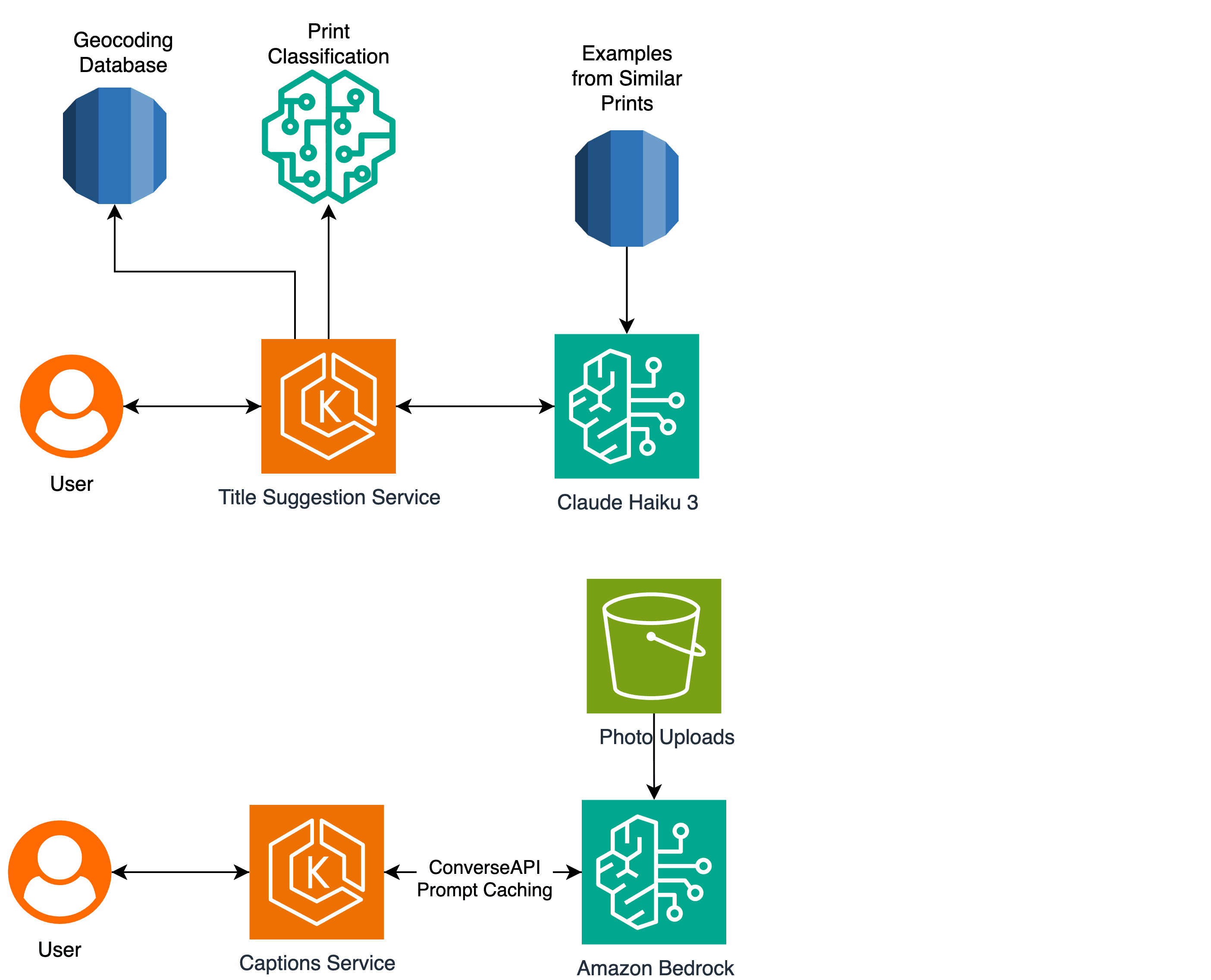
Artificial Intelligence How Popsa used Amazon Nova to inspire customers with personalised title suggestions This post was co-written with Bradley Grantham and Hugo Dugdale from Popsa. Popsa is a technology company that helps users rediscover and relive the meaningful memories hidden in their photo libraries. Available across more than 50 countries and 12 languages, we use design automation and AI to transform everyday photos into personal, shareable experiences, including beautifully printed Photo Books. In 2016, we released PrintAI, a pioneering algorithm to take complete control of creating a varied and interesting design from a user’s photos. Our customers could use the algorithm to create Photo Books that appeared professionally designed, in less than 5 minutes. A core philosophy of our business is that technology should do the heavy lifting for our users, so automation has always been an intrinsic part of our product. In the current Generative AI age, we can develop even more ways to elevate our customers’ experience, without making our software more complicated to use. In this post, we share how we applied Amazon Bedrock and the Amazon Nova family of models to reimagine our Title Suggestion feature. By combining metadata, computer vision, and retrieval-augmented generative AI, we now automatically generate creative, brand-aligned titles and subtitles across 12 languages. Using the unified API of Amazon Bedrock, Anthropic’s Claude 3 Haiku, and Amazon Nova Lite and Pro, we improved quality, reduced cost, and cut response times. This resulted in higher customer satisfaction, measurable uplifts in engagement and purchase rates, and over 5.5 million personalised titles generated in 2025. Generating title suggestions with Amazon Bedrock When a customer receives their Photo Book, the first thing they see is the front cover, with a prominent title and subtitle. A high-quality title and subtitle elevate a Photo Book’s design, however most customers aren’t professional copywriters and many of them settle for simple titles like “France 2024”, “Photos from Spain” or even, “Photos”. To help users elevate their photos, we developed and launched a feature called Title Suggestion, which has been available to our users since 2021. When users select photos for a Photo Book design, our mobile app reads metadata—such as timestamps and geocoordinates—from the images and runs on-device convolutional neural networks to extract relevant features. For example, whether the image contains a beach, a barbecue, or a pet. To use this data, we created an algorithm called Title Suggestion Graph. This algorithm used the metadata and data of the selected photos to build a list of possible titles, following a set of rules and templates to arrive at a set of suitable suggestions. For example: If all photos in the design were taken on the same day then suggest “On this Day” as a title with a subtitle of the specific date In June 2024, we identified an opportunity to improve Title Suggestion by applying generative AI, with the aim of inspiring our users with more creative titles. We began by clearly defining the problem and establishing evaluation metrics.Our solution…