An open-source spec for orchestration: Symphony

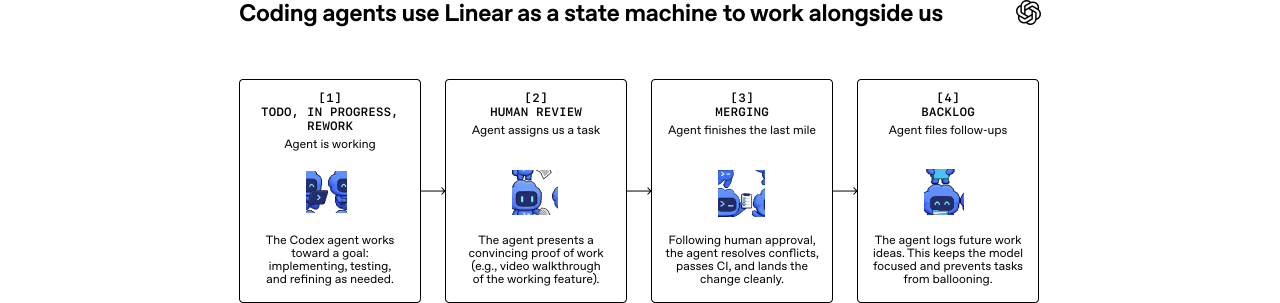
An open-source spec for Codex orchestration: Symphony By Alex Kotliarskyi, Victor Zhu, and Zach Brock Six months ago, while working on an internal productivity tool, our team made a controversial (at the time) decision: we’d build our repo with no human-written code. Every line in our project repository had to be generated by Codex. To make that work, we redesigned our engineering workflow from the ground up. We built an agent-friendly repository, invested heavily in automated tests and guardrails, and treated Codex as a full-fledged teammate. We documented that journey in our previous blog post on harness engineering. And it worked, but then we ran into the next bottleneck: context switching. To solve this new problem, we built a system called Symphony. Symphony(opens in a new window) is an agent orchestrator that turns a project-management board like Linear into a control plane for coding agents. Every open task gets an agent, agents run continuously, and humans review the results. This post explains how we created Symphony—resulting in a 500% increase in landed pull requests on some teams—and how to use it to turn your own issue tracker into an always-on agent orchestrator. The ceiling of interactive coding agents Even as they get easier to use, coding agents—whether accessed through web apps or CLI—are still interactive tools. As the scale of agentic work increased at OpenAI, we found a new kind of burden. Each engineer would open a few Codex sessions, assign tasks, review the output, steer the agent, and repeat. In practice, most people could comfortably manage three to five sessions at a time before context switching became painful. Beyond that, productivity dropped. We'd forget which session was doing what, jump between terminals to nudge agents back on track, and debug long-running tasks that stalled halfway through. The agents were fast, but we had a system bottleneck: human attention. We had effectively built a team of extremely capable junior engineers, then assigned our human engineers to micromanaging them. That wasn’t going to scale. A shift in perspective We realized we were optimizing the wrong thing. We were orienting our system around coding sessions and merged PRs, when PRs and sessions are really a means to an end. Software workflows are largely organized around deliverables: issues, tasks, tickets, milestones. So we asked ourselves what would happen if we stopped supervising agents directly and instead let them pull work from our task tracker. That idea became Symphony, a written spec that functions as a supervisor to orchestrate agentic work. Turning our issue tracker into an agent orchestrator Symphony started with a simple concept: any open task should get picked up and completed by an agent. Instead of managing Codex sessions in multiple tabs, we made our issue tracker the control plane. In this setup, each open Linear issue maps to a dedicated agent workspace. Symphony continuously watches the task board and ensures that every active task has an agent running in the loop until it’s done. If an agent crashes or stalls,…