Adversarial Reprogramming of Neural Cellular Automata
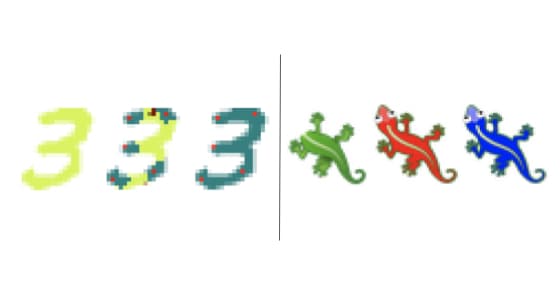
A robustness investigation. This article makes strong use of colors in figures and demos. Click here to adjust the color palette. In a complex system, whether biological, technological, or social, how can we discover signaling events that will alter system-level behavior in desired ways? Even when the rules governing the individual components of these complex systems are known, the inverse problem - going from desired behaviour to system design - is at the heart of many barriers for the advance of biomedicine, robotics, and other fields of importance to society. Biology, specifically, is transitioning from a focus on mechanism (what is required for the system to work) to a focus on information (what algorithm is sufficient to implement adaptive behavior). Advances in machine learning represent an exciting and largely untapped source of inspiration and tooling to assist the biological sciences. Growing Neural Cellular Automata In this work, we train adversaries whose goal is to reprogram CA into doing something other than what they were trained to do. In order to understand what kinds of lower-level signals alter system-level behavior of our CA, it is important to understand how these CA are constructed and where local versus global information resides. The system-level behavior of Neural CA is affected by: Perturbing any of these components will result in system-level behavioural changes. We will explore two kinds of adversarial attacks: 1) injecting a few adversarial cells into an existing grid running a pretrained model; and 2) perturbing the global state of all cells on a grid. For the first type of adversarial attacks we train a new CA model that, when placed in an environment running one of the original models described in the previous articles, is able to hijack the behavior of the collective mix of adversarial and non-adversarial CA. This is an example of injecting CA with differing model parameters into the system. In biology, numerous forms of hijacking are known, including viruses that take over genetic and biochemical information flow The second type of adversarial attacks interact with previously trained growing CA models by perturbing the states within cells. We apply a global state perturbation to all living cells. This can be seen as inhibiting or enhancing combinations of state values, in turn hijacking proper communications among cells and within the cell’s own states. Models like this represent not only ways of thinking about adversarial relationships in nature (such as parasitism and evolutionary arms races of genetic and physiological mechanisms), but also a roadmap for the development of regenerative medicine strategies. Next-generation biomedicine will need computational tools for inferring minimal, least-effort interventions that can be applied to biological systems to predictively change their large-scale anatomical and behavioral properties. Recall how the Self-classifying MNIST digits task consisted of placing CA cells on a plane forming the shape of an MNIST digit. The cells then had to communicate among themselves in order to come to a complete consensus as to which digit they formed. Below we show examples of classifications made by…
