Advancing the American AI Stack

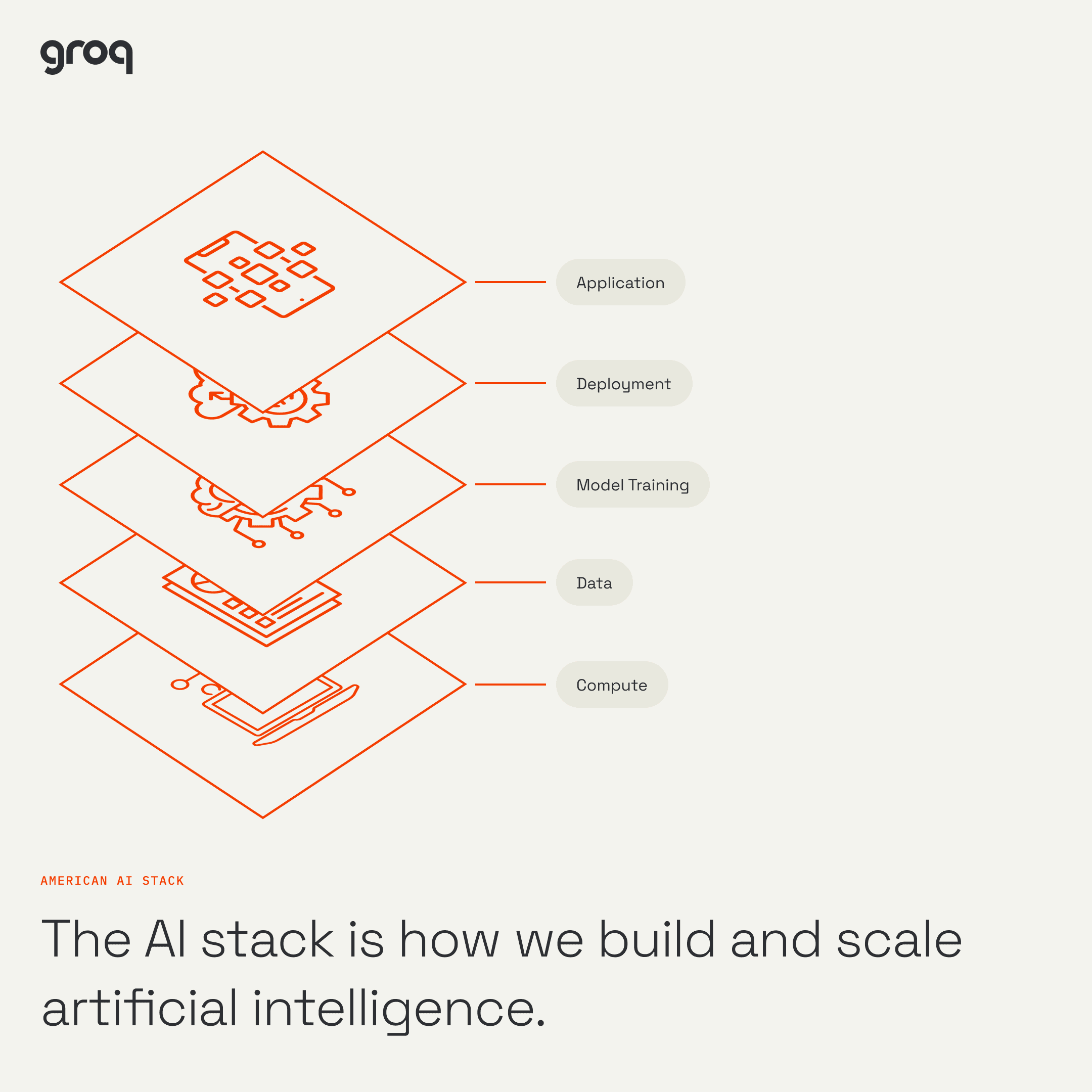
Advancing the American AI Stack Introduction Power has always flowed from the control of the world's essential resources. Once it was steel, then oil, then data. Today, it is AI compute, and specifically, the ability to run AI systems efficiently at global scale. Whoever controls AI compute will shape the century ahead. Compute is fast becoming the foundation of global economic growth. In the United States, investment in AI infrastructure—from data centers to semiconductors and energy systems—is already moving the needle: J.P. Morgan estimates that data-center spending alone could boost U.S. GDP by up to 20 basis points over the next two yearsFootnote 1. According to The Economist, investments tied to AI now account for 40 percent of America's GDP growth over the past year, equal to the amount contributed by consumer spending growth. That statistic would be staggering regardless of how long AI has been part of the economy, but this is just the start. The next decade of global competition will be defined not only by who invents the most powerful AI systems, but also by who can deploy and operate them securely, efficiently, and at scale. The real battleground increasingly centers on inference, the computational power required to run trained AI models and deliver real-time results to billions of users worldwide. While training compute builds AI capabilities, inference compute delivers them. As AI applications move from laboratory to deployment, inferenceFootnote 2 becomes the bottleneck that determines which nations can actually operationalize artificial intelligence at global scale. This is how the industry operates today and can serve as the model that informs U.S. export policy. The question facing policymakers is whether to recognize and enable the existing model of a vibrant American AI ecosystem, or to construct something entirely new. The evidence suggests that a nuanced approach to the former will better serve American strategic interests. Organizing an American AI Export Program The Trump Administration's Executive Order on Promoting the Export of the American AI Technology Stack (EO) recognizes that our allies are hungry for American compute, and that the United States must dominate the "away game" before geopolitical rivals fill the vacuum. This EO represents a watershed moment in American technology policy. Previous administrations treated AI exports primarily through a defensive lens, focusing on what to restrict rather than what to enable. The Trump Administration has inverted that paradigm, recognizing that American AI leadership depends not just on preventing adversaries from acquiring our technology, but on ensuring allies adopt democratically-aligned systems, standards, and operational models before alternatives take root. The stack in the EO and Groq’s definition of the "American AI Stack"—five discrete layers spanning hardware, data, models, orchestration, and applications—differ in how they designate each layer, but they both recognize that competitive advantage in AI infrastructure comes not from any single component, but from how the layers integrate into deployable systems. In real-world scenarios, how the compute systems and data architecture within the stack function and interact will be contingent on the stack’s overall structure and…